
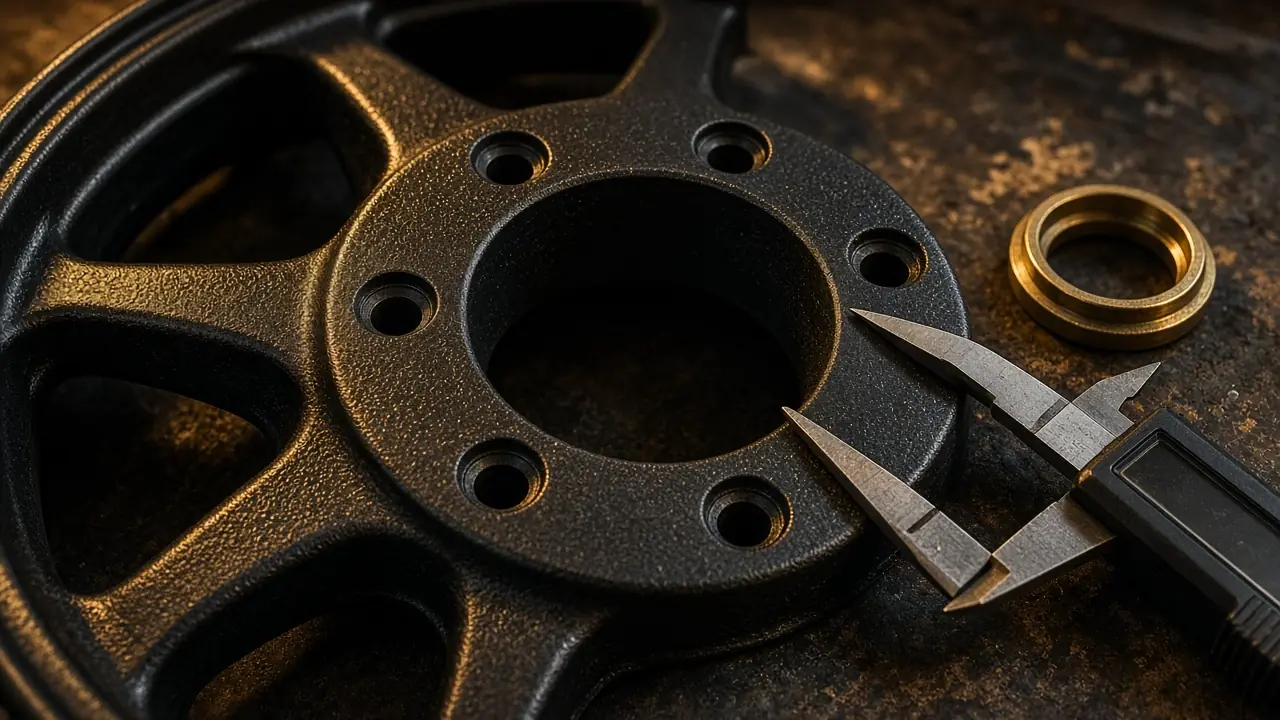
Every week someone drives in with a set of rims bought online that look right and fit wrong. The rim is not the problem. One of three numbers is.
PCD: the bolt pattern
PCD stands for pitch circle diameter. It is the number of studs and the diameter of the circle they sit on, written like 6x139.7. That one covers the Hilux, Ranger, Triton, D-Max, Navara and Fortuner. Older Pajeros and some Land Cruisers run 6x139.7 too, but with different centre bores, which is where people get caught.
A rim with the wrong PCD either will not go on, or will go on with the nuts slightly off-axis. The second case is dangerous because it looks fine in the car park and loosens on the highway.
Offset: where the rim sits in the arch
Offset, marked ET on the back of the rim, is the distance in millimetres from the rim's centre line to its mounting face. Positive offset pushes the wheel inward toward the suspension. Lower or negative offset pushes it outward toward the fender.
- Too low: the tyre rubs the fender on full lock or over bumps, and the wider track loads the wheel bearings.
- Too high: the inner tyre wall hits the upper control arm or the shock, usually on the inside of a turn.
- Just right: the tyre sits flush with the arch, clears the suspension through the full travel, and the steering feels like stock.
Going from a stock +30 to an aftermarket +0 moves each wheel 30 mm outward. On a stock-height truck with 265-wide tyres that is usually fine. Add a 2-inch lift and 285s and it is not.
Centre bore: what actually carries the weight
The centre bore is the hole in the middle of the rim. On a hub-centric fit it slides snugly over the hub lip, and that lip carries the vehicle's weight while the nuts simply clamp the rim flat.
Aftermarket rims are often cast with a large bore (73.1 mm is common) to fit many cars, and rely on plastic or alloy hub-centric rings to fill the gap. Skip the rings and the nuts have to centre the rim on their own. Even a half-millimetre error shows up as a vibration between 90 and 110 km/h that balancing cannot cure.
What we check before ordering
- PCD and stud thread against the vehicle, not the catalogue
- Offset and width against your tyre size and ride height
- Centre bore, and whether rings are needed
- Nut seat type (conical, ball or flat) matches the rim
- Load rating of the rim against the vehicle's GVW
It takes ten minutes and it is why rims fitted here do not come back for a second balance.
Related questions
What PCD is a Toyota Hilux?
Hilux models from 2005 onward use 6x139.7 PCD with a 106.1 mm centre bore and M12x1.5 wheel nuts.
Can I run a rim with a bigger centre bore?
Yes, with hub-centric rings that fill the gap. Without them the rim is located only by the nuts, which is the most common cause of high-speed vibration on aftermarket rims.
What offset is safe on a stock-height pickup?
For 17 to 20 inch rims at 8J to 9J width, offsets between +15 and +30 generally clear the fender and suspension on a stock-height Hilux, Ranger, Triton or D-Max. Lifted trucks and wider tyres change this, so measure first.